1
Followers
24
Following

Interrupting Soliloquy
I enjoy most things, and don't believe that enjoying things means that I shouldn't rip it apart critically.
Also don't think reading is the panacea of all ills, so I read a lot of comics and play a lot of video games.


Court of Fives
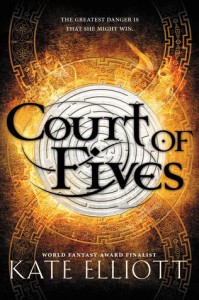 Let me say right off the bat that I liked the book. I started in as skeptical, because the summary for the book is not the best written, nor does it really represent the book as a whole. The summary gives off the impression that the "Commoners" are noble and free and whatnot (with all the noble savage undertones that that evokes), and that Jessamy wants to BE FREE and LIVE HER LIFE away from the "Patrons" she is forced to comply with. In fact, Jessamy is straddling a line between the two cultures, and she doesn't always bring out the best of both of them.
 Jessamy and her three sisters are the daughters of a Saroese/Patron-born man and a Efean/Commoner-born woman. Though her father isn't of particularly high birth, even the lowest born Saroese man is not allowed to marry an Efean woman. So though he has stayed with Jessamy's mother for twenty years, giving birth to four daughters (despite Saroese culture's hatred of them), they are not actually married, and none of the daughter are actually Saroese in a stable sense. This inability to definitely say that they are of the Patrons puts the family into absolute scrutiny. Any mistake, a toe out of line puts them further back than any typical Patron family. Thus, each of the sisters have their own thoughts and aspirations to make their futures more stable. The eldest wishes to sit the exam and become part of the Archivists, the youngest wants to obtain a good husband, a Patron husband, which makes her quite often come off as shallow and vain. Jessamy's twin sister, on the other hand, is loud and outspoken, who frequently mourns the lack of courage and self-possession she feels the family lacks, and despises the Patron culture she's forced into.
Jessamy is torn. She's not necessarily defiant like Bettany, but she doesn't want to merely go about with her head down, like the rest of her family. Jessamy only wants to run the Fives, where she feels she is treated like an equal, without gender, without class, only with her ability and skill. Her life revolves around this one indiscretion she has, and she is not particularly good at hiding it, as she later finds out.
Which is one of the things that I liked most about the book. I definitely did like the second half better than the first, because not only by losing everything does Jessamy realize how privileged she actually was, despite the inconveniences she experienced, but she also opens her eyes to the rest of her family, who she otherwise viewed as complacent, but have been living their lives in spite of their circumstances, beyond what Jes cared to see.
For example, I thought the most intriguing revelation was the fact that Amaya (the youngest) had been in a relationship with her "best friend". Considering that Jessamy refers to this "friend" as sort of a tag-along and seemed to have other less considerate opinions of her, the fact that the two of them had been a couple put her sister into a new perspective. One where finding a husband was a matter of survival, and though she wasn't without her pettiness and vanity, it wasn't a clear cut thing. Not to mention that of all the several teen books I've read, about maybe a fifth of them mention the fact that non-hetero relationships can happen at all, so I'm glad that this book is a part of that fraction.
By the end of the book, Jessamy isn't "fixed". She isn't a rebel fighting for the cause of "her people" or anything, but she is more open eyed to the historical rewrites, the actual divide between the two cultures and classes because of the no-nonsense shut downs she receives toward the end of the book from people she thought differently of or paid no attention to. The way that people draw attention to her privileges, the way that she is absolutely not exempt from them, the way that none of this is simple or without complication - this rounds this book up a couple of stars in my eyes. It's true that Jessamy is selfish, self-obsessed, and yes, close-minded, but the way that is integrated into the book and implied as something that will always leave room for improvement, allows it to be something other than a frustrating character trait we're forced to live with.
As for the harsher criticisms - I would say that the Fives is a bit ham-handed. Its presence in the book and its emphasis feels sort of forced (especially the way that everything, EVERYTHING is like the RINGS section which she is PARTICULARLY GOOD AT - sorry the book mentions this annoyingly often) The way that Jessamy thrives in a culture that is "neutral" puts me slightly on edge because I'm afraid it might veer towards that kind of mindset, where we're "color-blind" and stuff. But this is only the first book. I also really disliked Kalliarkos and that whole romantic aspect of it. Jessamy just manages to eek past the whole "I feel so confined by being upper class" because of her unique situation - Kalliarkos does not dodge this in the slightest at all. If anything he falls head, shoulders, knees, and toes into this frustrating, boring, and unoriginal archetype. The high-born equalizer who wants to be free. One can only hope that by the second book he has gotten a bit over himself and learns to use the system as opposed to avoiding it. The romance between them is also pretty forced as well, it's not like I'm opposed to romance for heaven's sake, but I would have preferred a slower build, as most of their relationship seemed informed (as in, other people keep mentioning it, as though if other people say it enough, it will be true!). It's definitely what stands out to be as the worst part. It's not the most terrible romance I've read, but if you're going for the Little Women parallel, Laurie and Jo were an easy couple because they were friends first (and for a good long while) before it went somewhere else. That just does not come across here.
I think it's worth a read for its examination of class, race, historical rewriting, etc.
